When you make a Google search today, how often do you click on the related site and look for the exact paragraph that has the answer to your question? While Google still shows its high-ranking websites, and users do scan through them, the practice of clicking into a website for information is slowly getting outdated.
All thanks to the AI revolution.
AI has changed almost every major sector worldwide, including digital marketing. SEO is not the same as it was five years ago. In 2026, “Googling” often involves typing in a query and having Google’s AI overview answer it.
This makes SEO experts worldwide wonder if AI is killing SEO.
If you think so, too, we have some food for thought!
The “Death of SEO” Narrative Vs. Reality
Is SEO dead?
The short answer is quite easy: No.
While SEO is far from being dead, its age-old perception definitely is. Especially after the dominance of Generative AI tools like ChatGPT, digital marketers have become increasingly skeptical about the future of SEO.
SEO in 2026 has mutated. It is no longer limited to stuffing keywords, buying cheap backlinks, and writing generic articles and blogs for traffic. While we are still creating original content and optimizing it, we are not doing it for Search Engines.
We are now optimizing our websites and their content for Answer Engines.
The New Landscape: From Search Engines To Answer Engines
If you have relied on the highlighted AI box at the top of your Google search results, you know what an Answer Engine is. These search tools scan the internet to answer your questions in the most human way possible. Instead of giving you a list of relevant websites, Answer Engines read the content from relevant websites to give you precise answers.
The dominance of tools like Google’s Search Generative Experience (SGE), SearchGPT, Perplexity, and more has changed the SEO game. AI chatbots and voice search assistants (Siri, Gemini, etc.) also have a significant contribution to this shift. The modern internet user need not go through multiple websites to find specific information on the internet. They can now get a single, tailor-made, and precise answer from Answer Engines.
This has led to the rise of “Zero-Click” searches. Here, internet users end their browsing sessions without clicking on a single website link.
While such changes have terrified marketers, we at Movinnza do not see this as an “apocalypse” for conventional SEO professionals. Instead, we see this shift as an opportunity for quality correction.
The AI revolution is ending the relevance of mediocre content on the internet. SEO writers in 2026 need strong writing skills to create unique content that stands out in a sea of AI-generated write-ups. Getting rid of all the fluff and spam, businesses are gravitating more toward “human-first” content.
This implies that the future of SEO doesn’t rely on robots that generate a thousand words in a minute. It relies on skilled humans who truly know and believe in the content they churn out
The “Traffic Drop” Myth: Why Volume Is Down But Value Is Up
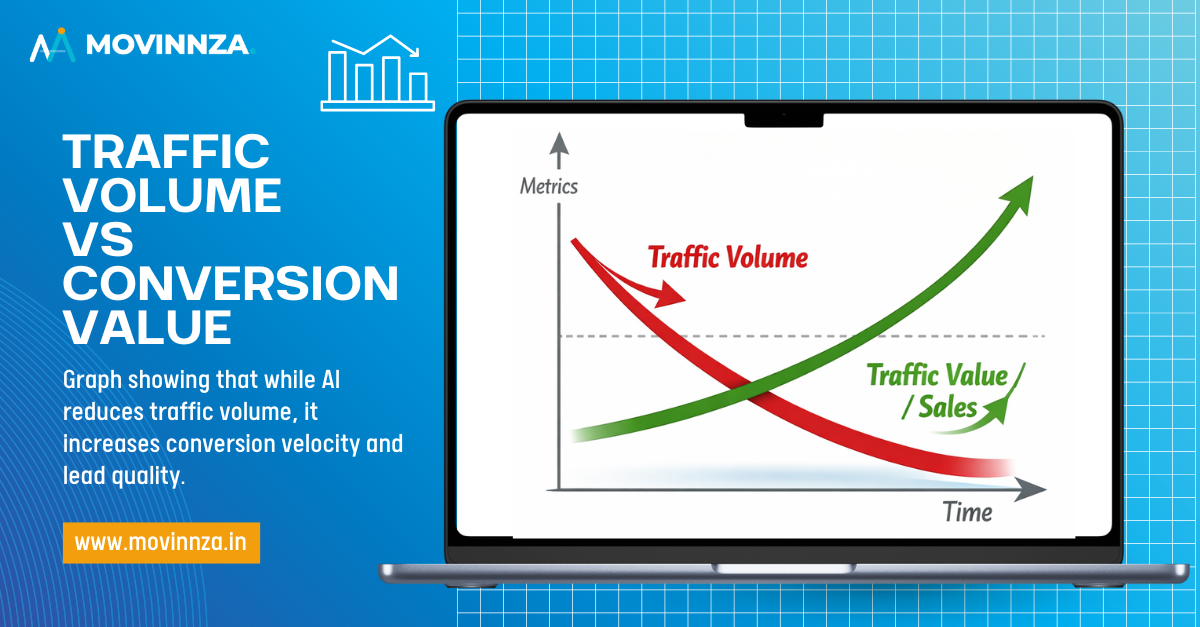
If you look at the current raw Google Search Console data, you may see a drop in total clicks on a site as compared to the clicks it received a few years back. This has scared many businesses and marketers, fearing a loss of reach.
However, a closer look at this situation makes things a lot clearer. In 2026, informational traffic will no longer give you clicks on your site. Questions like “What is the capital of France?” or “How many centimeters make an inch?” won’t drive traffic to a website. Answer Engines will directly answer such queries.
At Movinnza, we explain to our worried clients how this is a blessing in disguise. While the traffic volume may have gone down in 2026, the conversion velocity and traffic value have increased significantly.
Back in the day (that is, just a few years ago), most internet users would click on a bunch of websites, bounce from the most, and eventually consume relevant content or follow a call-to-action from the best site.
This is not the case anymore. In 2026, Answer Engines do the bouncing for you. They eliminate irrelevant sites and show you the most suitable and precise results. So, when you click on a website, AI has already filtered multiple options that you will not need. This reduces the number of clicks an internet user makes while browsing.
It is important to understand how AI-driven searches work if you want your business to thrive in 2026. You and your digital marketers should update your strategies according to the changing browsing trends, especially now that AEO is the new normal.
In this blog, we will focus on two of the most important shifts in AI-driven SEO: Answer Engine Optimization and E-E-A-T.
The Rise Of Answer Engine Optimization (AEO)
New-age searches have moved from Search Engine Optimization (SEO) to Answer Engine Optimization (AEO). SEO is more focused on using the right keywords and matching them with internet searches. AEO goes a step further and focuses on semantics and content structure.
Answer Engines do not just give you a list of websites with relevant content. They go through the content of all related sites, summarize it, and give you a precise overview. You must have seen tools like Gemini, ChatGPT, Perplexity, and more do this. These tools can scan thousands of sites within milliseconds.
If you want your website to shine in an age dominated by AEO, you need optimized content.
Here is what you can do to update your content strategy for AEO:
1. The Inverted Pyramid
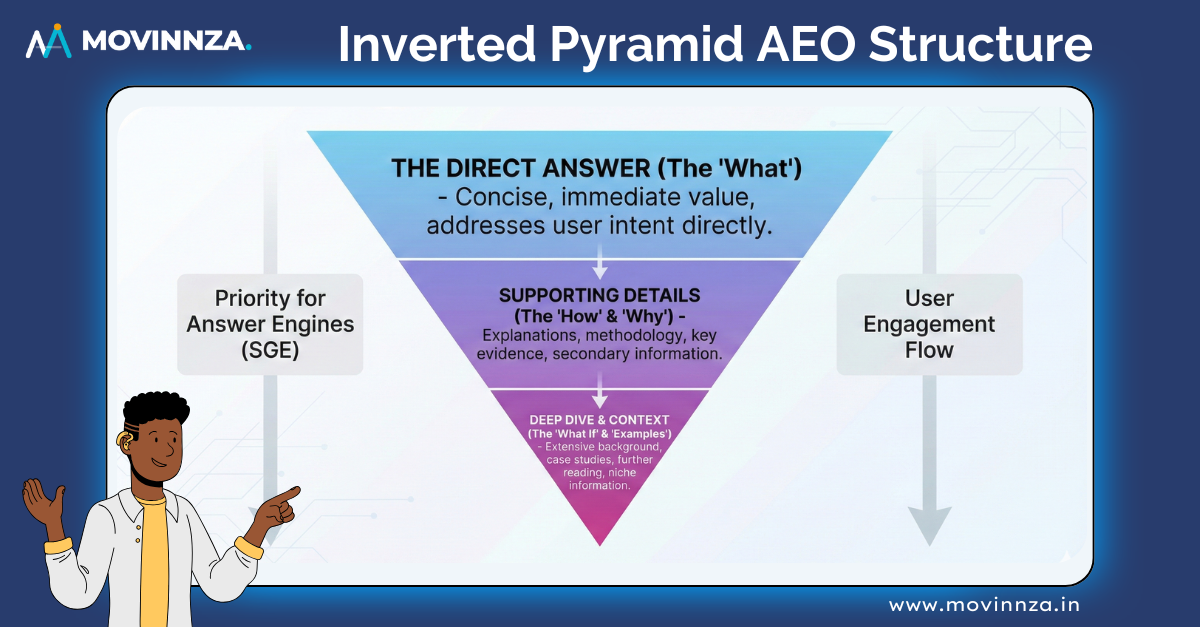
This is a content creation approach journalists have used for many years. It involves answering a question without any beating around the bush.
Let us explain.
Suppose there is a heading in your content that reads “Does AI influence modern SEO?” Following the inverted pyramid structure, you should answer this question immediately in the next line. Give a detailed explanation of your point later in your content.
Such an approach informs AI models that you know the answer. Once they get it, they can continue reading your content and index it accordingly.
2. Question-Based Architecture
More and more internet users are having conversations with Answer Engines and AI tools in 2026. This has changed new-age SEO from keywords to conversations. Internet users also talk extensively with voice AI assistants, especially by asking questions. For example, they won’t look for “best SEO company in Pune.” Instead, they would ask, “Which is the best SEO company in Pune?”
Considering this, your AEO strategy should include content that matches such question-based conversations.
New-age digital marketers and SEO experts in India should keep this in mind while optimizing websites. Their content should mirror this conversational tone. This way, Answer Engines would pick up their content in response to questions asked by internet users.
Here is what your writers should do:
-
Move away from vague headers, such as “Introduction,” “General Tips,” etc.
-
Include question-based headers (in H2 and H3) that match the queries of your target audience.
This will increase the chances of Answer Engines finding your content authentic, including it in their AI snippets/responses.
3. Structure Is The New Syntax
AI loves structured content as it makes its job easier. Large Language Models (LLMs) excel at reading and analyzing content that includes lists and tables. They usually struggle to extract specific data hidden inside the dense walls of text.
Here is what you can do to optimize your content structure for Answer Engines:
-
Replace lengthy paragraphs with HTML tables
-
Use ordered (numbered) lists (<ol>) to explain processes
-
Use unordered (bullet points) lists (<ul>) to list features
When you format your content this way, you “spoon-feed” AI with the information it needs.
Strategy Shift 2: The “Human Premium” And E-E-A-T
While AEO is all about understanding the machines reading and indexing your content, E-E-A-T involves understanding your target audience.
Here is the reality of 2026: AI is the world’s greatest parrot. It can read thousands of sites in milliseconds and summarize relevant content for you.
However, it cannot have experiences.
This is something that is uniquely human. AI has never run a marketing campaign. It has never fixed a leaky pipe. It has never experienced the anxiety of going for a job interview.
As fellow humans, digital marketers should use this to their advantage while optimizing their content for better reach. Google knows that the internet is full of AI content. This has made it update its Quality Rater Guidelines (E-A-T) by adding an extra “E,” leading to E-E-A-T (Experience, Expertise, Authoritativeness, and Trustworthiness).
This is where the “human premium” comes in. Create content that strikes the right chords and genuinely engages your audience. Doing so won’t just make your content unique, but also increase its value for search engines like Google. Ultimately, the Answer Engines will pick it up, giving you the desired reach.
Here is what you can do to drive traction in a world dominated by AI content:
Double Down On “Experience”
This may seem like generic advice, but it is extremely important to stand out from the clutter in 2026. It is always better to shift from creating “How-To” content to “How-I-Did-It” content.
Instead of simply telling your audience what to do, add your personal experience while sharing valuable information. Use first-person language (“I,” “We,” “Our,” “Us,” etc.) and be as transparent as you can. Feel free to share your failures, learning, and unique takes on subjects to prove how “human” your content is.
Choose Opinions Over Facts
In 2026, facts are free. You can directly speak to Siri, Alexa, or Gemini to get basic facts about anything in the world. You do not need long-form content like blogs or articles to do that for your audience.
Both internet users and Answer Engines today crave for perspectives.
While this does not mean discarding facts, it is always better to give your opinions while creating content. This adds a unique value to your content that no AI model can generate.
Do not be afraid to be a contrarian. If the world says, “AI is changing the world,” write an article about the things that have become worse in an AI-dominated world.
Always remember that nuance is AI’s worst enemy and an expert’s best friend.
Paint the subject matter with shades of gray. This will make your content engaging without trying too hard to appeal to your target audience. Show the world how unique, flawed, and imperfect the human perspective is.
Involve Proof Of Life
Use as much original media as possible in your website’s content. Adding more and more stock photos and videos will only signal Google that your content is just another “AI spam.”
Wherever possible, add real-life photos and videos to support your content. Add screenshots of actual dashboards. Do not hesitate to include imperfect media as long as it supports your content. It only proves that a human being in flesh and blood is behind the content generated.
Technical SEO In 2026: Speaking The Machine’s Language
Just like creating “Human-First” content builds your trust with humans, technical SEO builds it with machines. Technical SEO in 2026 is much more than creating sitemaps and fixing crawl errors. Its focus has shifted to translating content into a format LLMs can find, ingest, and verify.
No matter how relevant your content is, Answer Engines won’t cite your website in its answers if it cannot parse (analyze and describe) it.
Let us explore the three most important elements of technical SEO in 2026:
1. Schema Markup
Schema (structured data) is no longer an additional component that was nice to have. It has become the essence of AEO. AI models do not read websites like you and me. They search for structured clues to make sense of data and understand the context.
Here is what you can do:
Structured data breaks your content down into code-readable chunks. This makes it easy for AI models to understand context and include your site in their answers.
2. Entity SEO: Things, Not Strings
Traditional SEO focused on strings of text in the form of keywords. In 2026, Search and Answer Engines think in terms of entities (people, concepts, places, brands, etc.).
This makes it important for marketers to lay the groundwork for Answer Engines to understand specific entities holistically.
Suppose you want to Answer Engines to understand “Movinnza” not just as a word but as a unique entity – a reputed digital marketing agency in Pune. You want Google and its crawlers to understand its services, location, team members, and success stories for better reach.
To do so, prepare a robust and informative “About Us” page. Add clear links to your social media accounts (LinkedIn, Crunchbase, Instagram, etc.) and keep key details like name and address consistent.
When Answer Engines truly understand who you are, understanding what you want to say becomes easier.
Vector Search: Going Beyond Exact Matches
SEO, a few years ago, was laser-focused on matching exact keywords. In 2026, marketers have embraced vector search, increasing the need for semantic meaning.
In other words, you no longer need to limit yourself to specific keywords to reach your audience. You can use more suitable synonyms and related phrases to target the same audience.
As long as the Answer Engines and Search Engines understand what you are trying to say, you are good to go.
Movinnza’a Future-Proof Checklist: Your 2026 Action Plan
Now that we have discussed how AI does not ring the death knell for SEO and how you can thrive in the age of AEO, let us give you a checklist that prepares you for 2026.
While new trends will emerge and we will update you about them, here is Movinnza’s checklist you can use to audit your existing SEO strategy:
-
Audit For “Humanity”: Ensure that your web pages do not read like Wikipedia pages. They should sound like experts giving their unique opinions on something they know really well.
-
Use “Speakable” Schema: Add FAQ, HowTo, and Organization schema markup to your site. Spoon-feed AI models to tell them what they need to know.
-
Target Conversational Keywords: Move on from generic keywords with no more than a couple of words. Focus on longer and more complex keywords, preferably in the form of questions.
-
Build “Entity” Authority: Make your way to consensus to impress AI. Make organic PR efforts to get cited in industry journals, reputed websites, and portals that have authority.
-
Diversify Formats: Never limit your content to text. Use organic and real-world photos and videos enrich your website while making it more human.
Conclusion: SEO Is Alive, But Has Shed Its Skin
Coming back to our primary question of AI killing SEO, it is safe to say that SEO is very much alive and kicking. However, it has shed its older skin and is embracing AEO at lightning speed.
If you wish your business and brand to thrive digitally in 2026, you will need to speak the language of Answer Engines. Getting more clicks is no longer a KPI. Focus on creating unique and human-centric content that enhances your audience’s browsing experience.
At the same time, optimize your website and its content for Answer Engines to pick it up and include it in their summaries. If your audience finds these summaries helpful, they are bound to click on your site’s link (mentioned in the AI snippets) for engagement.
At Movinnza, we strongly believe that the shift to AEO is not a hurdle. It is just a filter that reduces unnecessary noise and highlights true subject matter experts.
If you wish to embrace this aspect of new-age digital marketing, we would love to team up with you to build a future-proof strategy.
Let us build a future-proof strategy that impresses both humans and machines, giving you the reach you have always wanted!



.png "Google Ads ROI Strategies: Maximize Your Campaign Revenue")